Maersk Deepens Saudi Footprint With Stake in Jeddah Terminal as Red Sea Trade Gains Strategic Weight
PR Newswire
JEDDAH, Saudi Arabia, Feb. 26, 2026
JEDDAH, Saudi Arabia, Feb. 26, 2026 /PRNewswire/ -- Saudi Ports Authority announced that APM Terminals, a wholly owned subsidiary of A.P. Moller–Maersk, has acquired a 37.5% stake in the South Container Terminal at Jeddah Islamic Port, reinforcing the Danish shipping giant's long-term commitment to Saudi Arabia's logistics transformation and the growing strategic importance of the Red Sea corridor.
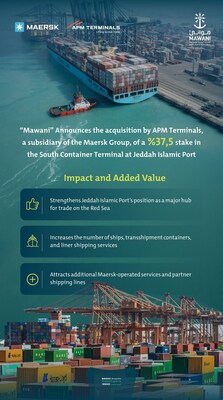
The move positions Jeddah more firmly within Maersk's global ocean network and signals increasing alignment between multinational shipping operators and Saudi Arabia's economic diversification strategy under Vision 2030.
Vision 2030 and the Logistics Pivot
Under Saudi Vision 2030, the Kingdom has prioritized logistics as a cornerstone sector, aiming to transform Saudi Arabia into a global supply chain hub connecting Asia, Europe, and Africa. The National Transport and Logistics Strategy seeks to elevate the country's ranking in global logistics performance indices and significantly expand port capacity and efficiency.
By consolidating its position in Jeddah, Maersk is aligning with these ambitions. The enhanced integration of the South Container Terminal into Maersk's operational ecosystem is expected to increase container throughput, expand direct service offerings, and improve maritime connectivity between Saudi Arabia and major global trade routes.
The Red Sea's Expanding Trade Role
The Red Sea remains one of the world's most critical maritime corridors, linking the Indian Ocean to the Mediterranean via the Suez Canal. Roughly 10% to 15% of global trade volume is estimated to transit through the broader Red Sea–Suez corridor annually, making port infrastructure along its coastline strategically significant for global supply chains.
Jeddah Islamic Port, the largest port on the Red Sea coast, currently operates 62 multipurpose berths and serves as a principal gateway for Saudi imports and exports. The South Container Terminal alone features five advanced berths with a handling capacity of 4.1 million TEUs.
With Maersk's stake, industry analysts expect increased vessel calls and stronger integration into long-haul trade routes, potentially positioning Jeddah as a more prominent transshipment and distribution node for the wider region.
Competitive Positioning: Jeddah vs. Regional Giants
The investment also sharpens competitive dynamics across the region's major maritime hubs.
Jebel Ali Port in Dubai remains the Middle East's largest container port and a longstanding regional benchmark for efficiency and connectivity. Meanwhile, the Suez Canal continues to dominate as a global chokepoint linking European and Asian markets.
By strengthening Maersk's operational presence in Jeddah, Saudi Arabia is signaling its intention to capture a larger share of regional trade flows and transshipment activity, leveraging its geographic position along the Red Sea while investing heavily in port modernization and logistics infrastructure.
For Maersk, the 37.5% stake represents more than a financial transaction; it reflects a strategic recalibration toward integrated port ownership and deeper vertical control within key maritime gateways.
As global supply chains continue to rebalance amid geopolitical shifts and evolving trade routes, infrastructure investments along the Red Sea are likely to play an increasingly pivotal role in shaping the future of global commerce.
Photo - https://mma.prnewswire.com/media/2920126/Mawani.jpg
Logo - https://mma.prnewswire.com/media/2920125/Mawani_logo.jpg
 View original content to download multimedia:https://www.prnewswire.com/news-releases/maersk-deepens-saudi-footprint-with-stake-in-jeddah-terminal-as-red-sea-trade-gains-strategic-weight-302698318.html
SOURCE Mawani